
Why Market-based Curtailment Is the Hidden Asset in Your Solar Strategy
Imbalance costs, and market volatility are turning fixed PV production into a liability. Market-based PV curtailment helps protect margins and generates up to 30.000 per MW in value.
Market-based PV Curtailment generates up to €30,000 per MW.
Imbalance costs and market volatility are transforming fixed solar production from an asset into a financial risk. Market-based PV curtailment provides operators with a strategic lever to protect margins, optimize revenues, and unlock additional system value — turning flexibility into measurable profit.
As more industrial sites install PV systems, the number of negative-price hours on the electricity market continues to rise. In 2024, Belgium reached a record high. In 2025, the trend accelerates even faster.
For sites with dynamic contracts, the financial impact is significant. Many installations now face long stretches where PV injection generates no income or even results in a net cost. This is due not only to negative prices but also to imbalance penalties when actual production deviates from forecasts.
‘We used to optimise for solar production. Now, we optimise for value. That means knowing when not to inject.’ Laurenz Peleman, Energy Partner
Analysis showed that curtailing PV at the right moments could preserve up to €30,000 per MWp in value. That figure is based on 2023 with less extreme volatility than 2024. The approach involves using a gateway device that receives real-time market signals and adjusts PV injection accordingly. In practice, this can mean partial or full curtailment, depending on market conditions.

Imbalance costs, and market volatility are turning fixed PV production into a liability. Market-based PV curtailment helps protect margins and generates up to 30.000 per MW in value.
Market-based PV Curtailment generates up to €30,000 per MW.
Imbalance costs and market volatility are transforming fixed solar production from an asset into a financial risk. Market-based PV curtailment provides operators with a strategic lever to protect margins, optimize revenues, and unlock additional system value — turning flexibility into measurable profit.
As more industrial sites install PV systems, the number of negative-price hours on the electricity market continues to rise. In 2024, Belgium reached a record high. In 2025, the trend accelerates even faster.
For sites with dynamic contracts, the financial impact is significant. Many installations now face long stretches where PV injection generates no income or even results in a net cost. This is due not only to negative prices but also to imbalance penalties when actual production deviates from forecasts.
‘We used to optimise for solar production. Now, we optimise for value. That means knowing when not to inject.’ Laurenz Peleman, Energy Partner
Analysis showed that curtailing PV at the right moments could preserve up to €30,000 per MWp in value. That figure is based on 2023 with less extreme volatility than 2024. The approach involves using a gateway device that receives real-time market signals and adjusts PV injection accordingly. In practice, this can mean partial or full curtailment, depending on market conditions.
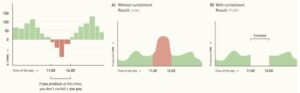
The curtailment typically works through the inverter (Sunspec protocol) combined with a Gateway. It reduces injection to match on-site consumption or respond to market triggers, such as negative prices or high imbalance costs. The aim is not to switch off renewables entirely, but to steer them more intelligently.
Even in cases where the PV system is owned by a third party, curtailment can be explored. Adjustments in contracts or shared incentives are possible.
Curtailment is also compatible with broader energy flexibility strategies. It does not limit future integration of batteries, electrified heat, or other assets. Instead, it operates as a first step that aligns with more advanced forms of flexibility.
Why this matters for energy-intensive sites?
Market-based curtailment can unlock up to €30,000 per MWp per year, with limit hardware impact. Want to know the value potential for your site? Contact your Energy Manager today.